
Scaling clean energy in humanitarian frontiers: Powering the transition to Solar e-Cooking
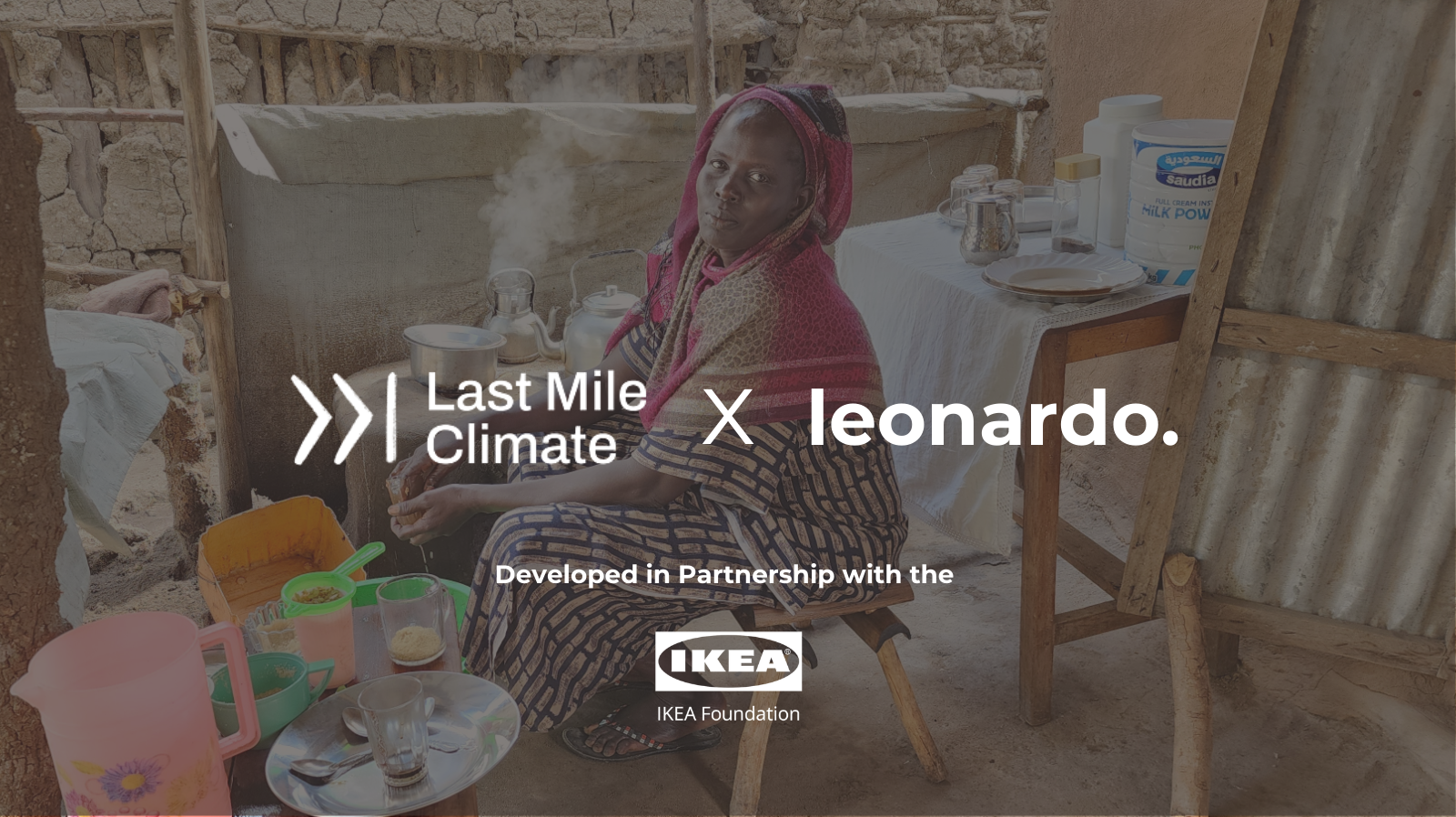
The transition to clean cooking is a fundamental driver of health, gender equality, and environmental sustainability, yet for millions of families in displacement settings, it remains out of reach. In these humanitarian contexts, the daily reality is a hazardous reliance on biomass, which traps households in cycles of poverty, significant health burdens, and environmental degradation. To secure the large-scale climate and private financing required to disrupt this cycle, organizations need a rigorous, evidence-based understanding of the status quo. leonardo partnered with Last Mile Climate (LMC) to provide the evidentiary backbone for their flagship initiative: SOLCO – The Solar Electric Cooking Partnership for Humanitarian Contexts, supported by the IKEA Foundation.
“We have chosen leonardo as our trusted solution for monitoring and evaluation because they bring together domain expertise in scientific impact measurement; vast experience in collecting meaningful data in challenging contexts; and a data-driven technology platform that helps us to draw insights from the data.”
Jakob Øster, Founder and Executive Director at Last Mile Climate
The partner: Last Mile Climate
Last Mile Climate (LMC) is a non-profit organization that builds Climate Action Partnerships to connect grassroots, humanitarian, and government actors with private-sector solutions. Their SOLCO initiative is a Climate Action Partnership co-led UNEP and GPA, implemented in collaboration with global, national, and local partners. SOLCO acts as a multi-stakeholder platform designed to enable affordable access to solar-electric cooking for displaced families and their host communities. The partnership’s vision is to revolutionize cooking across Africa by transitioning more than:
- 250,000 households to solar-electric cooking by 2027
- Leveraging a minimum of $100 million in financing
This initiative aims to transform cooking while championing environmental sustainability and economic development through the creation of green jobs within the solar-electric value chain.
The Challenge: Impact Measurement in complex settings
Designing a system to measure the baseline reality of cooking in displacement settings across Kenya, Nigeria, and Uganda was a complex undertaking that required navigating unique humanitarian frontiers. Key challenges included:
- Operationalizing in remote refugee camps: Data collection took place in some of the most vulnerable environments, including Bidibidi, Rhino Camp, Kyaka II, and Kiryandongo Refugee Settlements in Uganda, and the Kakuma Refugee Camp in Kenya.
- Cohesion across an extensive partner network: A primary challenge involved centralizing self-reported data from a vast array of over 30 partners and thousands of end-stakeholders (including refugees) into one coherent, rigorous impact management system.
- Varying residential realities: The study had to account for different residence statuses, including settlements in Uganda dominated by refugees, Monguno in Nigeria composed of IDPs and host community members, and urban Nairobi with mostly host-community residents.
- Deep baseline gaps: In many rural and displacement contexts, there was no reliable pre-existing data on fuel costs, material well-being, or cooking-related safety, making primary data collection essential.
- Safety and sensitivity risks: Collecting sensitive information regarding physical and verbal abuse in overcrowded camp settings required strict scientific rigor and data privacy protocols to ensure responses were authentic and plausible.
The Approach: Scientific rigor at the last mile
To build a high-integrity evidence base across these complex surroundings, leonardo and LMC implemented a multi-country research strategy throughout 2025:
1. Strategic Timeline and Geographic Scope (2025):
- April: 340 households surveyed in Monguno, Nigeria.
- September: 1,137 households surveyed in Uganda (Bidibidi, Rhino Camp, Kyaka II, and Kiryandongo Refugee Settlements).
- October: 531 households surveyed in Kenya (Kakuma Refugee Camp and the Nairobi City Metropolitan Area).
2. Locally-Led data collection: A total of 2,008 face-to-face interviews were conducted. In Nigeria and Uganda, leonardo trained staff from local partners, including AYAN, CECI, and GISCOR, to ensure scientific precision. In Monguno, a split-group design compared "Future Customers" with a "Control Group" to isolate future impact accurately.
3. Digital integrity and validation: All data flowed into leonardo’s Impact Management Platform (IMP). The system utilized an AI-powered data quality audit consisting of representativity, consistency, and integrity assessments to ensure findings were authentic and unbiased.
“We are proud to partner with Last Mile Climate to turn complex field data into actionable insights. By establishing this high-fidelity baseline, we are providing the transparency needed to unlock climate finance and prove that a transition to solar e-cooking is not just an environmental necessity, but a profound socio-economic opportunity for those living at the last mile.”
Dr. Jan Moellmann, Co-Founder & CEO at leonardo.impact
Findings: The social impact of biomass reliance
The baseline results delivered a striking picture of the human and economic costs of biomass reliance within these refugee-hosting areas:
- The energy access gap: Outside of urban Nairobi, in all surveyed refugee settlements and IDP sites, clean cooking access is virtually non-existent, lingering between 0% and 2%.
- A "Time Poverty" trap: Households spend an average of 18.8 hours per month collecting fuel. In the Monguno (Control) group, this burden spikes to a staggering 47 hours per month, stealing time from education and income-generating activities.
- The safety crisis: Fuel collection is overwhelmingly the burden of women (80%). In Kiryandongo, only 20% of respondents reported "Never" experiencing abuse; 61% reported sometimes experiencing physical or verbal abuse, while 19% faced it frequently or regularly.
- Chronic health risks: 39% of all households reported illnesses directly linked to cooking fuel smoke. In areas with the highest biomass reliance, such as Kiryandongo and Rhino Camp, reported illness rates reached 85% and 58% respectively.
- Economic strain: Despite living in extreme material poverty, households spend an average of USD 8.53 per month on fuel. In Nairobi, this cost rises to USD 12.94, a massive financial hurdle for families already scoring far below national wealth benchmarks.
- Climate and environmental consequences: The sheer scale of biomass consumption is immense; households using collected firewood consume an average of 42.97 kg per month, driving localized deforestation and conflict over resources. Globally, this reliance on traditional fuels is a major source of black carbon and CO₂ emissions, accelerating the climate crisis while destroying vital carbon sinks.
The Way Forward: Implementation and continuous monitoring
The baseline results reveal meaningful differences across sites that can guide the next steps of implementation for SOLCO partners. Variations in household size, residence status, wealth, and fuel use point to the need for tailored approaches in each context. While urban sites like Nairobi offer lower-hanging opportunities for market-based strategies, refugee settlements and low-wealth rural areas may require stronger support mechanisms. These findings also provide useful direction for pricing and product design, as the ability to pay differs significantly across locations.
At the same time, the data highlights where the potential for impact is greatest. High fuel costs, carbon-intensive fuels, long collection hours, health problems, and safety risks remain widespread. These are exactly the challenges solar electric cookstoves are designed to address, suggesting strong opportunities for meaningful improvements in daily life. Evidence of this significant socio-economic impact can add value to carbon credits and drive down end-user costs for e-cooking. As this study establishes the baseline, future assessments will monitor how these conditions evolve and how solar electric cookstoves influence household well-being.
Get to know Last Mile Cilmate - and support their amazing work.
Want to know more?
Get in touch with us and and start to measure impact confidently.