
A living room for a new neighbourhood in Mainz: Measuring the impact of the Kreuzpunkt im Viertel
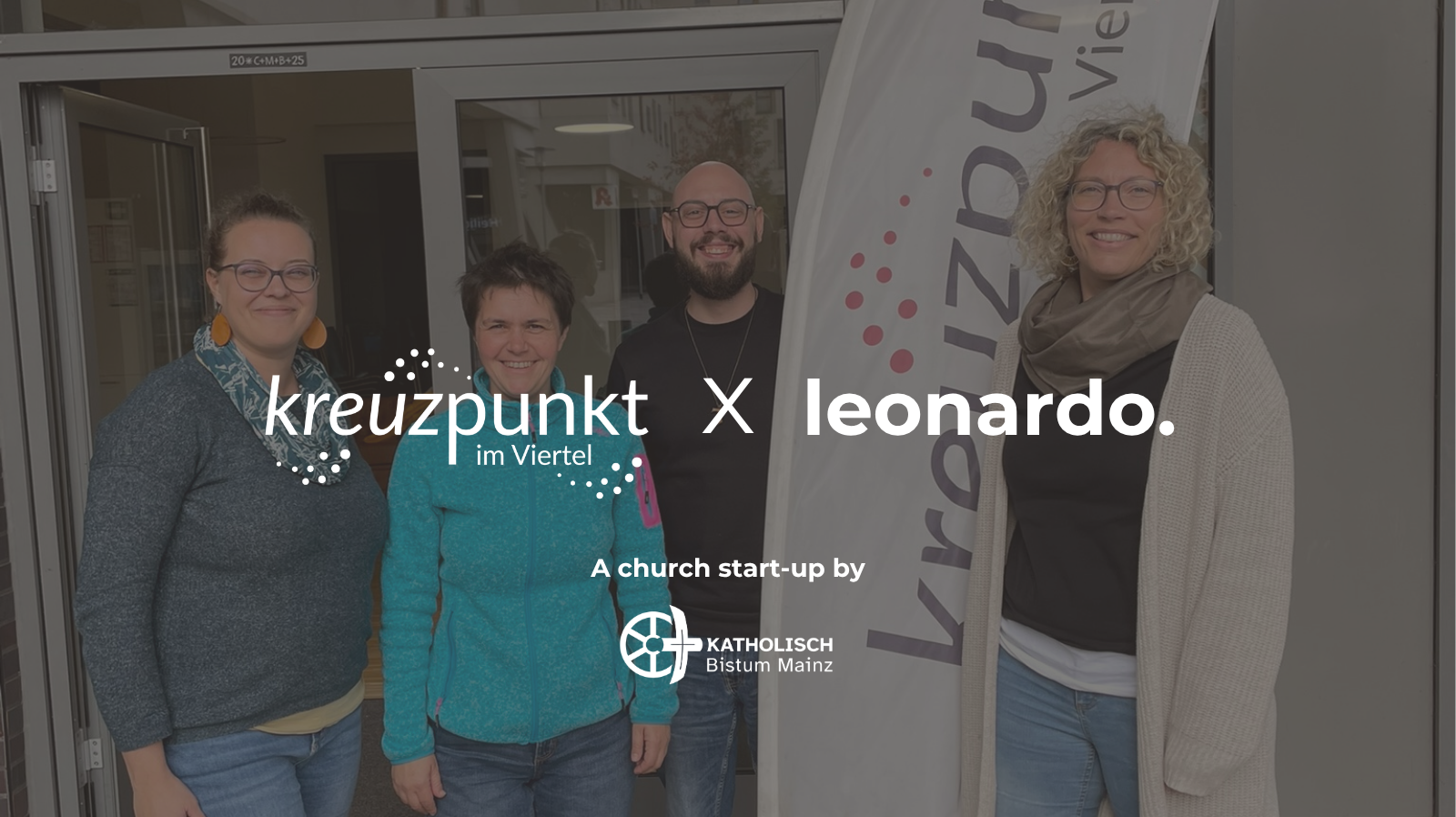
How Kreuzpunkt changed the perception of the church
The Heiligkreuzviertel is one of Mainz's newest neighbourhoods, rising on the site of the former IBM campus and home to thousands of new residents. Since 2020, the Kreuzpunkt im Viertel has given this still-growing quarter an open, unbranded "living room," run by the Bistum Mainz and open to everyone regardless of age, origin or confession. Five years in, the diocese wanted to know whether the concept was working, and how people actually experienced it. leonardo partnered with the Kreuzpunkt to measure exactly that.
Findings at a glance
The results tell a consistent story, and a striking one: People feel at home at the Kreuzpunkt, they meet neighbours they would otherwise never have crossed paths with, and for a notable share of them, the experience has changed how they see the church itself.
- 97% feel truly welcome and valued
- 92% made new friendships there
- 84% met people of a different age, background or origin, and 96% deeply valued those experiences
- 64.95 Net Promoter Score, a level considered excellent across industries and rare for a community initiative
- 30% say their view of the church changed, always in a positive direction.
When we opened the Kreuzpunkt, we could feel that something was working, but feeling it and proving it are two different things. The study gave us evidence for what we experience every day: that people feel genuinely welcome, that friendships form across every kind of boundary, and that church can be open, nearby and human. On the strength of these results, the Bistum Mainz has extended the project from the end of 2026 through to at least 2030, a mandate to keep building together with the people of the quarter.
Judith Reinsch, Pastoralreferentin and Project Manager at Kreuzpunkt im Viertel
The partner: Kreuzpunkt im Viertel and the Bistum Mainz
The Kreuzpunkt im Viertel is an open, inclusive meeting place in the newly built Heiligkreuzviertel. Founded in August 2020 as a pastoral start-up, the Kreuzpunkt occupies a 140 m² space in the Heiligkreuzviertel. It rests on three pillars: a network that connects people across the quarter, a platform for self-realisation where residents bring their own ideas to life, and occasional urban interventions, small impulses around meaning, mindfulness, community and faith. Rooms can be used for people's own projects against a voluntary donation, and a small team of pastoral and Caritas staff keeps the doors open several days a week.
Behind the initiative stands the Bistum Mainz, a diocese of around 600,000 Catholics currently engaged in a wide-ranging renewal process (the Pastoraler Weg). As a funder of pastoral innovation, the diocese acts here not as an authority but as an enabler, making space for a project that meets people directly in their daily lives. The Kreuzpunkt is one of its flagship examples of what a nearby, contemporary church can look like.
The challenge: Measuring the "soft" impact of a welcome
The Kreuzpunkt's effect is precisely the kind that is hardest to capture, a sense of belonging, a feeling of being welcome, a quietly shifted perception of an institution. Making that measurable, and credible, required careful design. Key challenges included:
- Quantifying intangibles. The project's core outcomes, such as trust, belonging, feeling valued and a changed image of church, are relational and emotional rather than easily counted. These "soft" factors had to be turned into valid, comparable indicators rather than anecdotes.
- A genuinely mixed audience. The Kreuzpunkt deliberately serves people of every confession and none. The survey had to speak to committed Catholics, members of other faiths, and the explicitly non-religious alike, without assuming a shared vocabulary of faith.
- Integrity of self-reported data. As with any voluntary online survey distributed through a project's own channels, the results needed rigorous verification to be trustworthy to the diocese and external funders.
The approach: A shared impact logic, then rigorous measurement
leonardo and the Kreuzpunkt team built the evidence base in three steps:
1. A shared impact logic (2020–2025). The collaboration began at a Bistum Mainz innovation workshop in Frankfurt in February 2025, and continued from September to November 2025 with the joint definition of the Kreuzpunkt's impact logic. Nine impact goals, from social integration to living the Christian faith invitingly, were translated into concrete, answerable indicators.
2. A focused survey. A structured 41-question online questionnaire was mapped directly onto those indicators. Between January and April 2026, 103 visitors took part (50% men, 44% women, 2% non-binary, 4% no response), recruited through the Kreuzpunkt's own channels to reach its actual user community.
3. Digital integrity and validation. All responses flowed into leonardo's Impact Management Platform, where an AI-supported data-quality audit assessed representativity, consistency and integrity, complemented by manual plausibility checks. Because the survey runs continuously, this is a live feedback loop rather than a one-off snapshot.
So much of what a place like the Kreuzpunkt does is easy to feel but hard to see: the quiet work of welcoming people, building trust and living community values day after day. Impact measurement makes that visible. It gives an initiative the language and the evidence to show what its everyday activities actually create, so that the team, its partners and the community itself can recognise that value and decide, on solid ground, how to carry it forward.
Manuel Müller, Sr. Impact Measurement Consultant at leonardo. impact
Findings: Welcome, connection and a changing view of church
Three things stand out in the results: How welcome people feel, how effectively the space brings different backgrounds together, and how that experience shifts perceptions of the church behind it.
A place that matters for life in the quarter
For a project only five years old, in a neighbourhood still under construction, the Kreuzpunkt has become remarkably load-bearing:
- A near-universal sense of welcome: 97% of respondents feel welcome and valued, 80% "completely", a strong confirmation that the "living room" concept is landing as intended.
- Central to community life: 94% say the Kreuzpunkt is important for community life in the Heiligkreuzviertel, and 81% call it personally important to them. In a quarter that arrived without ready-made meeting places, it has become one.
- A best-in-class recommendation score: The Kreuzpunkt earns a Net Promoter Score (NPS) of 64.95, a level considered excellent across sectors and outstanding even among community initiatives, where attachment already runs high. Only 4% report ever having had a negative experience.
Bringing different backgrounds together
New neighbourhoods throw together people who would otherwise rarely cross paths, and the Kreuzpunkt turns that proximity into real connection:
- Trust and new relationships: 91% trust the people they meet there, and 92% have made new friendships or acquaintances, evidence of a space that works as a social catalyst rather than just a venue.
- Bridging across backgrounds: 84% have met people who differ from them in age, social background, or cultural and religious origin: 79% across cultural origins, 74% across older and 65% across younger generations, 65% across socio-economic backgrounds, and 58% across religious lines.
- Valued, almost unanimously: 96% appreciate the chance to meet people with different ways of life, and 79% say those encounters gave them genuinely new perspectives.
The space works both ways: 50% of respondents have used it for their own ideas or projects, all of them successfully, and 56% have engaged there for others or the common good, turning a meeting place into a launchpad for local initiative.
Church, experienced differently
- Faith without a threshold. 78% experience the Kreuzpunkt as a place where faith is lived openly and invitingly, including for people without any church affiliation.
- Broad endorsement. 95% welcome the church's engagement in a project like this.
- Perceptions genuinely move. Among those who reflected on it, 30% say their overall image of the church has changed, a striking figure given how durable such views usually are.
By simply being present in the quarter, the Kreuzpunkt makes the church tangible as an approachable, socially relevant neighbour, and for a meaningful minority it breaks open a stereotype that rarely moves.
The Way Forward: A mandate through 2030
Conceived as a five-year project with a review point in 2026, the Kreuzpunkt now has its answer. On the strength of these results (the best-in-class NPS, the near-universal sense of welcome, and the demonstrable relevance of the place for a good life in the neighbourhood), the Bistum Mainz has extended the project from the end of 2026 through to at least 2030. What began as an experiment in pastoral presence has become a durable part of the Heiligkreuzviertel's social fabric.
The evidence also sets a clear agenda. Two-thirds of respondents (67%) want new formats, from sports and yoga courses (especially for mothers with young children) to clothing swaps, language help, meditation and programmes for young people. With half the community already using the space for their own ideas and every one of them succeeding, the strategic opportunity is to turn a valued meeting place into a genuinely co-created quarter centre. Because the survey runs continuously, the team can act on those wishes and measure their effect in near real time, a living feedback loop rather than a closing report. A deeper follow-up analysis, focused on how the new, community-initiated formats strengthen belonging and self-efficacy over time, will follow later this year.
We would like to thank the whole Kreuzpunkt team, in particular Judith Reinsch and Maike Jakob, for their engaged and trusting collaboration, Dr. Brigitte Lob (Dezernat Seelsorge | Innovationsförderung) for her strategic support, and Andere Zeiten e.V. for generously helping to make this impact analysis possible. Our deepest thanks go to the 103 participants whose honest voices are the heart of this study.
Get to know the Kreuzpunkt im Viertel and support their amazing work.
Want to know more?
Get in touch with us and and start to measure impact confidently.