
How does an accelerator know who's still in business six years after graduation?
A case study on how Impact Hub Istanbul and voi tracked six years of Empowering Women in Agrifood (EWA) alumni to see whether a food-and-agriculture accelerator's impact actually held up over time.
- A full study conducted within 10 days: All 26 alumni interviews, spanning six program years from 2020 through 2025, were completed inside about ten days.
- No external research institution required: IH Istanbul used voi to build the indicator set and ran the retrospective interviews autonomously. No need to hire an external firm to run an alumni-tracking study
- Real founders telling real stories: : Respondents answered by voice in Turkish, and voi followed up live wherever an answer opened into a longer story.
- Based on scientific standards: study contained acknowledged constructs for measurement rigor such as: Perceived Entrepreneurial Capability (Liñán & Chen, 2009) Investor Readiness (GIIN IRIS+), Business Financial Resilience (World Bank Global Findex) among others.
- Impact Proof: a Net Impact Score of 92 and an average recommendation of 8.5 out of 10, every number traceable to a specific founder's own words.
- A new network established as response to the data: Already surfaced a fix the founders asked for directly, a real alumni network, not just a completed program, with named, specific gaps like alumni who don't yet know each other well enough to work together.
Voices recorded
About
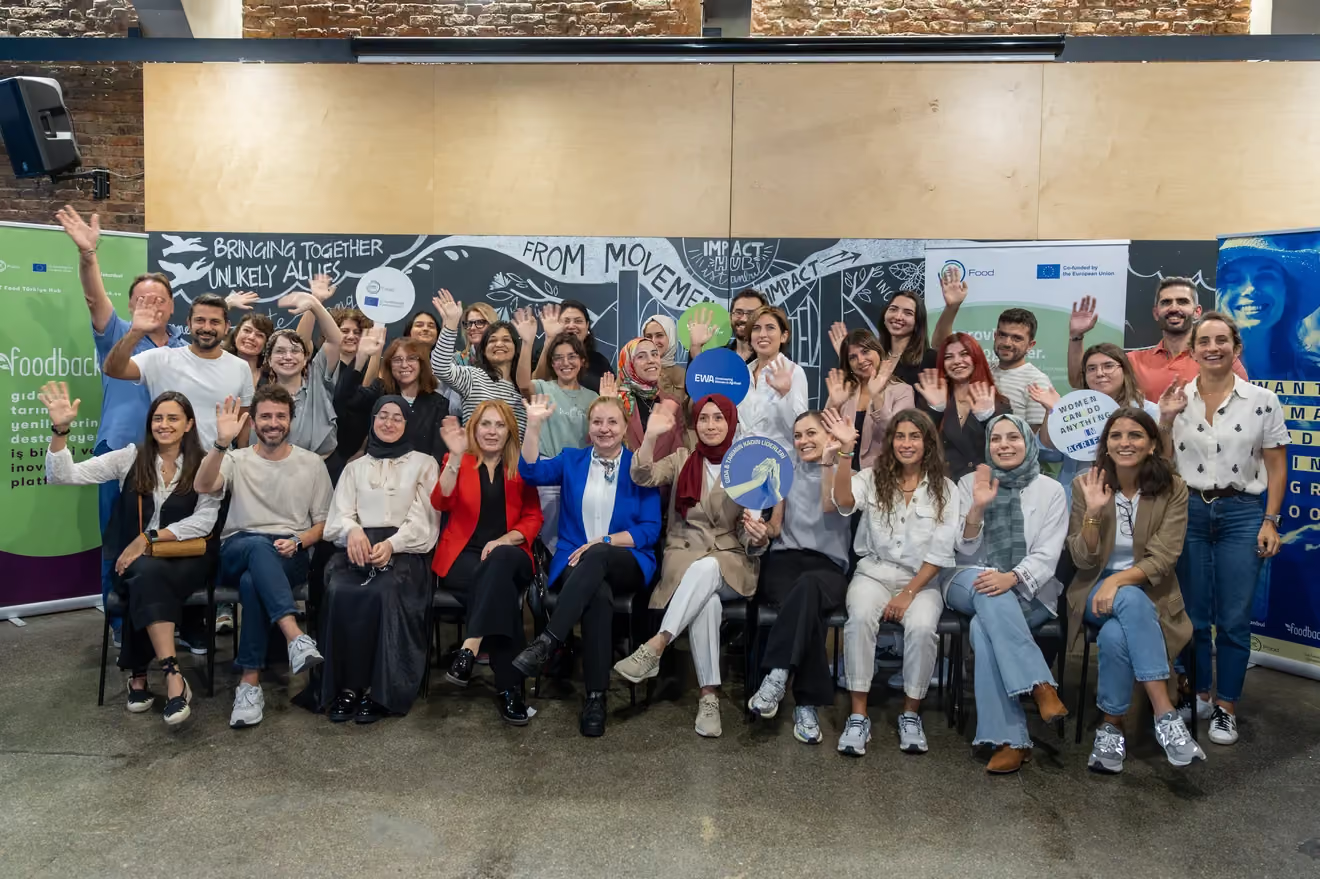
Proving an accelerator worked right after graduation is easy. Proving it worked five years later usually means a slow, expensive longitudinal study. EWA, the food-and-agriculture support program and alumni network run by Impact Hub Istanbul, has run cohorts every year since at least 2020, taking in founders at the idea stage and early-stage startups. The hard question was what happens once they leave the initiativeImpact Hub Istanbul used voi to ask that question of 26 alumni spanning six program years, from 2020 through 2025. voi interviewed all of them by voice, in Turkish, and turned six years of scattered cohorts into one comparable dataset without commissioning a separate alumni study for each year.
The Challenge
Asking a founder how a three-month program went right after it ends is one thing. Asking a founder how it went five years later, once the world has thrown its own successes and setbacks at her business in between, is a different problem entirely.
- Six cohorts, one instrument: alumni from 2020 through 2025 were all answering from wherever they are now, so time-since-program varied enormously across respondents, and a single snapshot survey risked treating a founder five years out the same as one five months out.
- Depth in less than two weeks: A five-year retrospective study, normally a multi-month research project on its own, ran start to finish in ten days.
- Adding a story to a score: not numeric KPIs alone, voi allowed founders to add answers in long, free-flowing voice responses.
The Approach
26 alumni across six program years, from 2020 through 2025, responded, most having joined EWA at the idea stage or as early founders.
- Indicator selection: voi built out a wide set of constructs, entrepreneurial confidence, investor readiness, peer network quality, venture survival, and financial resilience, letting founders speak to whichever parts of that journey actually applied to their own history with the program.
- AI-run voice interviews in Turkish: founders answered by voice, and voi followed up live wherever an answer opened into a longer story, like asking one founder to keep going when she described her venture's path from an idea-stage cohort to an international web of Impact Hub relationships.
- Retrospective attribution, not generic satisfaction: voi asked founders what specifically changed since joining, what contributed to it, and how different things would be without the program, so credit for change could be traced back to EWA rather than assumed.
Findings
The numbers describe a program that worked for most people, plus two specific things worth taking seriously rather than averaging away.
- Positive impact is close to universal: 96% of the 26 alumni reported a positive experience, for a Net Impact Score of 92 and an average recommendation of 8.5 out of 10.
- Different measures converge on the same number: Cohort comparisons surface a mixed pattern rather than a uniform trend. Among the first cohorts (2020-2021), 66% of participants reported meaningful skill gains, compared with 75% in the 2025 cohort. Application of that learning runs the other way: 100% of participants in the first cohorts reported actively applying what they learned, against 63% in the 2025 cohort. Quality-of-life improvement shows the largest shift, from 33% in the first cohorts to 100% in 2025.
- Most ventures are still standing: 65.4% of the businesses founded or grown through EWA are still operating today, and participants connected with an average of 21.1 different organizations and stakeholders across sectors along the way.
- Financial resilience is the real gap: only 30.8% of ventures could cover a major unexpected expense without disrupting operations, meaning most still couldn't, a specific and fixable weakness distinct from the otherwise strong skill and confidence numbers.
- Network creation as a learning opportunity: multiple founders mentioned a desire to strengthen the alumni network as a way of continuing collaboration after the program ended.
The Way Forward
Impact Hub Istanbul now has something most accelerators never get: proof that the effect of a mentorship program is still measurable years after the cohort photo was taken, broken down cleanly across six different program years rather than buried in one all-time average.
That gives EWA a foundation to build on rather than guess at. Founders are already naming what they want more of, tighter, more regular contact with fellow alumni, and because voi captured that in their own words rather than a satisfaction checkbox, Impact Hub Istanbul knows exactly what to build next, and can run this same study again next year to see whether it worked.
Get to know Impact Hub Istanbul and EWA and support their work building Türkiye's food-and-agriculture entrepreneurship ecosystem.
Want to know more?
Get in touch with us and and start to measure impact confidently.