
The OXUS Kyrgyzstan Women Client Study: Listening to women borrowers in Central Asia
It was especially meaningful to hear direct feedback from women clients and gain a deeper understanding of how our work impacts them.
Aimonchok Zhuzupbekova, ESG Manager at OXUS Kyrgyzstan (OKG)
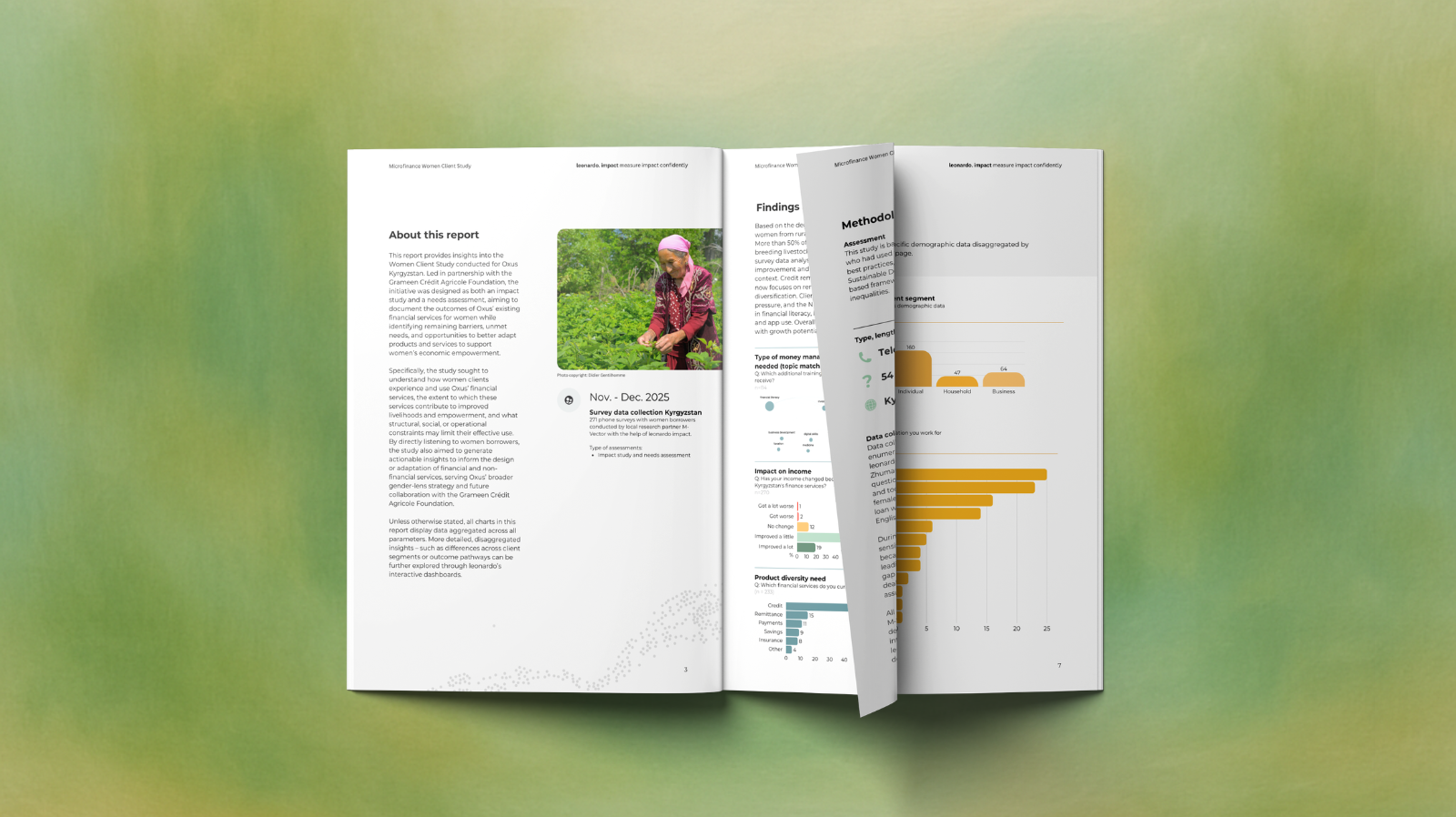
That sentiment captures the ambition behind this study. We're publishing the OXUS Kyrgyzstan Women Client Study, conducted in partnership with the Grameen Crédit Agricole Foundation (GCAF) and delivered together with local research partner M-Vector. Between November and December 2025, we listened to 271 women borrowers across rural and urban Kyrgyzstan to understand how OKG's loans affect income, well-being and women's agency, and what unmet needs remain.
What the study found
The data shows a portfolio that meaningfully supports women's livelihoods, alongside clear opportunities to deepen impact:
- Income and well-being improve for most clients. 83% of women report improved income; 83% report a better quality of life. Only 9% find repayment hard or very hard, well below the Asia benchmark of 22%.
- Confidence is rising, but rarely transformative. 78% of women report improved financial confidence, but only 10% say "very much improved", far below the 40% global benchmark for women microfinance clients.
- Loan decisions are often shared; repayment is solo. In rural areas, women frequently decide loan use jointly with their households, yet around 80% carry sole responsibility for repayment.
- Demand is moving beyond credit. Credit remains the most-needed service (53%), but nearly half of women now want remittance, payment, savings or insurance products.
- Financial education is wanted but rarely offered. Only 7% of women have attended a financial education programme; 31% would like to. The most-requested topics are financial literacy, investment and credit management.
Download the full Microfinance Women Client Study here for deep analysis, methodological notes, and the full set of charts.
Who took part
The study reached 271 women clients across OKG's regions of operation: 70% rural, 30% urban, most aged between 31 and 60, with 160 individual borrowers, 64 business owners and 47 household representatives. The sample reflects OKG's portfolio mix of business (53%), agriculture (23%), consumer (20%) and housing (4%) loans, with livestock purchase, trade working capital and equipment repair the most common loan purposes.
How the data was collected
The 54-question survey follows recognised scientific standards, with indicators aligned to the SDGs, the CGAP Women's Economic Empowerment framework and the Global Findex. Enumerators from M-Vector, trained by leonardo and supervised by Alexandra Zhumanalieva, conducted telephone interviews in Russian, Kyrgyz and English. All responses flowed into leonardo's Impact Management Platform (IMP), where an AI-powered data quality audit assessed representativity, consistency and integrity before findings were finalised.
leonardo. distinguishes itself through its flexible methodology that enables Financial Service Providers to deeply engage with outcome measurement processes. We successfully collected valuable outcome indicators that provide insight into women's perceptions regarding how the FSP's products and services impact their lives. Additionally, this process established a foundation for meaningful dialogue with the FSP on these topics, creating opportunities for future client-centered collaborations.
Edouard Sers, Head of Risk, Compliance and Impact at GCAF
The way forward
The evidence confirms OKG's strong foundation as a women-serving financial service provider, especially in rural agricultural contexts where loans stabilise income and protect quality of life. The opportunity now is to evolve a largely credit-only model into a broader product mix, with savings, insurance and remittance services that build resilience for the roughly one in three women who remain economically fragile. Light-touch financial literacy, cash-flow management and digital-skills training would help convert incremental confidence gains into deeper agency. Operationally, clearer communication on interest rates, repayment schedules aligned with clients' income cycles and stronger digital onboarding would translate the 94% trust in credit officers into long-term loyalty, and lift the Net Promoter Score (currently 26.14) closer to industry leaders.
Read the full story
For the longer narrative behind this partnership, including how the study was designed and the segment-level findings, read our full case study.
The OXUS Tajikistan impact report follows the same methodology and shows how outcomes differ across the region. Explore the findings here.
Get to know Grameen Crédit Agricole Foundation and Oxus Kyrgyzstan and support their amazing work.
Want to know more?
Get in touch with us and and start to measure impact confidently.